Local SEO in 2026: The Google Business Profile and Website Checklist

SEO


When someone searches "car rental near me" or "limo service in Niš", Google shows a map with three businesses before any regular results. Those three get most of the calls.
Local SEO is the work of making your business one of those three. It rests on two things working together: a complete, active Google Business Profile and a website with clear service and location pages, consistent business details and real reviews.
Local search has changed a lot in the last two years. AI Overviews now appear for many local questions, Google AI Mode answers "which company should I call" type queries and customers check reviews more carefully than ever. But the foundations are the same, and most local businesses still skip half of them.
This is the checklist we use for every client with a physical location or a service area, from car rental and limo companies to manufacturers and clinics.
How Local Search Works in 2026

Google has been open about how it ranks local results. In its guide to improving local ranking, it names three main factors:
Relevance. How well your profile and website match what the person searched for.
Distance. How far your business or service area is from the searcher or the location in the query.
Prominence. How well known and trusted your business is, based on reviews, links, mentions and your website.
You can't change distance, but you can make it clear. Relevance and prominence are where almost all local SEO work happens, and both depend on your website as much as on your profile.
Google Business Profile vs Website: Who Does What
Job | Google Business Profile | Website |
|---|---|---|
--- | --- | --- |
Show up in Maps and the local pack | Main driver | Supports relevance and prominence |
Explain services in detail | Short descriptions only | Full service and location pages |
Collect reviews | Primary place | Show and reinforce them |
Convert visitors | Call, directions, website button | Booking, quotes, forms, prices |
Appear in AI answers | Facts, hours, ratings | Clear, quotable content |
Build long-term rankings | Activity and reviews | Content, links and authority |
Businesses that treat these as separate projects usually underperform. The profile brings people in. The website convinces them and gives Google the details it needs.
The Local SEO Checklist We Use for Every Client
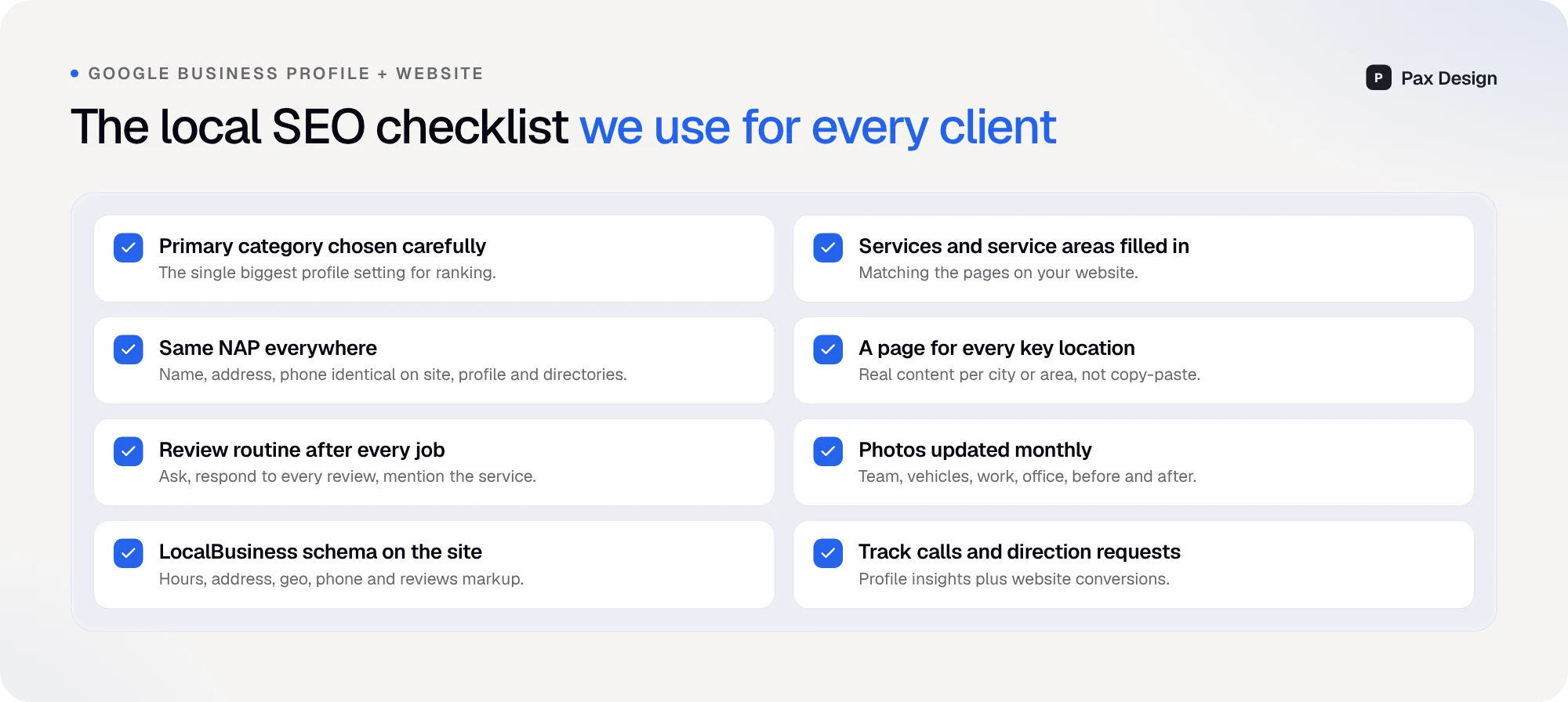
1. Choose the Primary Category Carefully
The primary category is the single most important profile setting. Pick the one that describes your core business, such as "Car rental agency" or "Limousine service", and add secondary categories only for services you really offer.
2. Fill In Services and Service Areas
List every service and the areas you actually cover. Use the same names you use on your website, so Google sees the match between profile and site.
3. Keep Name, Address and Phone Identical Everywhere
Your business name, address and phone number (NAP) should be the same on your website, profile, social media and directories. Small differences, like an old phone number on a directory, weaken trust.
4. Create a Page for Every Key Location
If you serve several cities or neighbourhoods, each important one deserves its own page with real local content. More on this below.
5. Build a Review Routine
Ask for a review after every finished job, respond to every review, good or bad, and encourage customers to mention the service and the location. A steady flow of new reviews matters more than a big batch once a year.
6. Update Photos Every Month
Upload real photos of your team, vehicles, work, office and before-and-after results. Profiles with fresh photos look active, and customers trust what they can see.
7. Add LocalBusiness Schema to Your Website
Structured data helps Google connect your website with your profile. Google's documentation on local business structured data shows which properties to include, such as address, opening hours, phone and geo coordinates.
8. Track Calls, Directions and Form Leads
Profile insights show calls, website clicks and direction requests. Combine them with website conversions so you know which part of local SEO actually brings clients.
Location Pages That Rank vs Doorway Pages

Location pages are one of the most powerful local SEO tools and one of the most abused. Many websites create dozens of pages where only the city name changes. Google's spam policies call these doorway pages, and they can hurt the whole site.
A location page that ranks has real content for that area:
Local details. Delivery points, routes, landmarks, local projects or the neighbourhoods you serve.
Area-specific information. Prices, delivery times or availability for that location.
Local proof. Reviews from customers in that city and photos of work done there.
Proper linking. The page is reachable from the menu or the main service page, not hidden.
For a car rental company, that could mean a page for airport delivery with exact pickup points, and a page for the city centre with parking details and opening hours. For a contractor, it could mean a page per city with recent projects from that area.
Example Structure of a Strong Location Page
Here is the outline we use when we write a location page for a service business:
H1 with service and place. "Car Rental at Niš Airport" or "Custom Shower Enclosures in Belgrade".
A short answer. What you offer in that location, the starting price and the most important fact, such as delivery time.
Local details. Pickup points, neighbourhoods, distances or recent projects in that area.
Prices and conditions. What is included, what changes the price and any local differences.
Proof from that area. Two or three reviews from local customers and real photos.
FAQ. Questions people from that area actually ask, like parking, delivery hours or travel time.
Clear next step. Booking form, quote calculator or a phone number that is answered.
Written this way, each page is useful to a real visitor first, which is exactly why it ranks and gets quoted in AI answers.
Reviews: The Local Signal You Control Most
Reviews influence rankings, clicks and conversions at the same time. A business with a 4.9 rating and hundreds of recent reviews looks like the safe choice before anyone reads a word of its website.
A simple review routine:
Ask in person when the job is done and the customer is happy.
Send a short message the same day with a direct review link.
Reply to every review within a few days, using the customer's name and the service.
Show selected reviews on your website, near the booking or contact buttons.
You can automate steps two and three. We explain how in our guide to website automation for small businesses.
Real Example: Local Trust Signals on the Inter Limo Homepage

The website we built for Inter Limo Service, a limo and rent a car company in Niš, puts local trust signals right where visitors decide:
Who and what, instantly. The brand, limo service and rent a car are named in the first line of the homepage.
Reviews on the homepage. Real client feedback sits next to the booking buttons, so proof comes at the moment of decision.
One tap to WhatsApp. Local customers prefer messaging, so the channel they actually use is always visible.
These details help conversions directly, and they also give Google and AI search clear signals about what the business is and how trusted it is.
Local SEO and AI Search
AI Overviews and AI Mode increasingly answer local questions directly: "best limo service in Niš", "car rental with airport delivery near me". They draw on the same signals as local rankings, plus the content of your website.
Businesses that appear in these answers usually have:
A complete profile with accurate hours, categories and many recent reviews
Service and location pages that answer specific questions in plain text
Consistent business details across the web
We cover this in more depth in our guide on getting into Google AI Mode and ChatGPT answers.
Local SEO for Transport and Rental Companies
Car rental, limo and transfer companies have specific local opportunities:
Airport pages. Dedicated pages for each airport you serve, with pickup details and prices. See our guide to airport transfer websites.
Delivery locations. Hotels, train stations and business districts where you deliver vehicles.
Fleet pages. Real photos and details of the vehicles people search for, like "van rental" or "SUV rental".
Seasonal pages. Ski season, summer travel, events and conferences in your city.
Our list of car rental website features and our car rental web design page show how these pages fit into a complete site.
Common Local SEO Mistakes
Choosing a vague or wrong primary category
Using a different phone number on the website and the profile
Creating city pages with copied text
Ignoring negative reviews instead of answering them
Never updating photos or posts on the profile
A website that doesn't mention the cities and areas you serve
No tracking, so nobody knows which local efforts work
If you'd like to see why the broader SEO foundations still matter, read our article on why ignoring SEO in 2026 is expensive.
A 30-Day Local SEO Plan
Week | Focus | Tasks |
|---|---|---|
--- | --- | --- |
1 | Profile | Categories, services, areas, hours, description, photos |
2 | Consistency | Fix NAP on website, social profiles and main directories |
3 | Website | Improve service pages, add one strong location page, add schema |
4 | Reviews | Start the review routine, reply to all existing reviews |
After the first month, keep a simple rhythm: new photos and a profile post every month, a review request after every job and one improved or new page every few weeks.
Conclusion: Local Rankings Follow Local Clarity
Local SEO is not a trick. It's the result of telling Google, AI search and customers exactly what you do, where you do it and why people trust you, consistently on your profile and your website.
If you want to know what's holding back your local rankings, book a free website audit and we'll review your Google Business Profile and website together.
Frequently Asked Questions
What is the local pack?
The local pack is the map with three businesses that Google shows for local searches. It appears above most regular results and gets a large share of clicks and calls.
How long does local SEO take?
Profile improvements can show results within weeks. Location pages, reviews and authority usually take two to six months to make a clear difference, depending on competition.
Do I need a website if I have a Google Business Profile?
Yes. The profile helps you appear in Maps, but the website provides the detailed content, trust signals and conversion paths that support rankings and turn visitors into clients.
Can I rank in cities where I don't have an office?
You can rank organically with useful location pages, but the map results depend heavily on your verified address and service area. Be honest about where you operate.
How many reviews do I need?
There is no fixed number. Aim to have more recent reviews than your main local competitors and a steady flow every month.
Does responding to reviews help SEO?
Responding shows that the business is active and cares about customers. It helps conversions and trust, and Google recommends replying to reviews.
What is LocalBusiness schema?
It is structured data on your website that describes your business name, address, phone, opening hours and location in a format search engines understand.

Lazar J.


